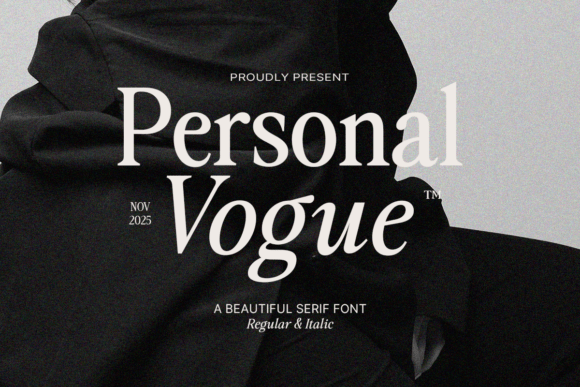
Personal Vogue: A Typeface for Commanding Elegance
There are fonts that simply set text, and then there are fonts that set a tone. Personal Vogue belongs firmly in the latter category. This is a typeface that doesn't just display words; it presents them. As a stunning, high-contrast serif font, it carries an immediate air of sophistication and luxury. Its DNA is rooted in the classic Bodoni revival, but with a distinctly modern, editorial sensibility. You see it in the dramatic interplay of its ultra-thin hairlines and its bold, commanding main strokes. This contrast is what gives it such a powerful visual punch. The beautifully curved terminals and tall, proud ascenders give every letterform an aspirational quality, making it feel right at home on the pages of a high-fashion magazine or the logo of an exclusive brand.
The Personal Vogue family includes both a Regular and an Italic style. The italic is particularly noteworthy. It’s not just a slanted version of the regular weight; the letterforms flow with a subtle, rhythmic movement that adds personality without sacrificing the high legibility the family is known for. This makes it a versatile premium font for more than just headlines. It can bring a refined, sophisticated feel to pull quotes, subheadings, or even short blocks of body copy where you want to inject a sense of style and grace.
Where This Serif Font Truly Shines
Choosing the right typeface is about matching personality to purpose. Personal Vogue’s personality is one of prestige, clarity, and modern elegance. It’s a display font at heart, built to make a statement. Consequently, its most natural habitat is in projects where conveying a sense of premium quality is paramount. Think logo design for a boutique law firm, a luxury skincare line, or a high-end real estate agency. Its strong, clean lines ensure the brand identity is both memorable and professional.
In editorial design, it excels. Use it for the masthead of a magazine, the title of a feature article, or chapter headings in a beautifully produced book. The font’s inherent drama captures attention and sets an authoritative, sophisticated tone from the first glance. For packaging design, especially in the cosmetics, fragrance, or gourmet food sectors, Personal Vogue can elevate a product on the shelf. It communicates quality and care before the customer even reads the description. The same principle applies to web design. While it’s too ornate for long-form body text on a screen, it’s perfect for hero sections, key headlines, and call-to-action buttons on websites for luxury hotels, architectural firms, or exclusive membership clubs.
Don’t limit its use to purely commercial applications, either. Content creators and bloggers can use it to create impactful social media graphics. A quote card set in Personal Vogue Italic, or a YouTube thumbnail title using the Regular weight, instantly looks more polished and intentional. For personal projects like wedding invitations, milestone announcements, or a portfolio website, this creative font adds a layer of bespoke elegance that generic system fonts simply can’t match.
Making It Work: Practical Guidance for Designers and Creators
Having a powerful design asset like Personal Vogue in your toolkit is one thing; using it effectively is another. Its high-contrast nature means it demands space to breathe. Avoid setting it at very small sizes, especially on screen, where the delicate hairlines can become fragile and difficult to read. It’s a font for moments of impact, not for dense paragraphs of information. For body copy, always pair it with a highly legible sans serif font or a simpler serif font that can handle the workload of long-form reading.
Speaking of font pairing, this is where strategy comes into play. Personal Vogue has a strong voice, so it needs a partner that complements rather than competes. A clean, geometric sans serif like Montserrat or a humanist sans serif like Lato can provide a beautiful, modern contrast. If you prefer an all-serif palette, look for a transitional or old-style serif with lower contrast for the body text, ensuring a clear visual hierarchy. The goal is to let Personal Vogue be the star of the show in headlines, while its partner handles the supporting role with quiet efficiency.
Before committing, always test the font with your actual content. See how it handles the specific words and letter combinations in your project. Review the full character set—a good commercial font like this one includes extensive language support, ligatures, and stylistic alternates that can solve specific typographic problems and add unique flair. Finally, ensure you understand the licensing. If you’re using it for a client’s logo, a product for sale, or a high-traffic website, you’ll need the appropriate commercial license. Treating font licensing as a fundamental part of your project budget is a mark of a professional designer, marketer, or publisher.
In the end, Personal Vogue is more than just a collection of glyphs. It’s a tool for building a brand identity that resonates with quality and confidence. It’s about making a deliberate choice to communicate prestige. When your project calls for a voice that is both commanding and incredibly delicate, this is the typeface that answers the call.